Extended Images of Post-War Modernist Sculpture
Alicija Bogacka, Boris Beja, Matic Gabrovec
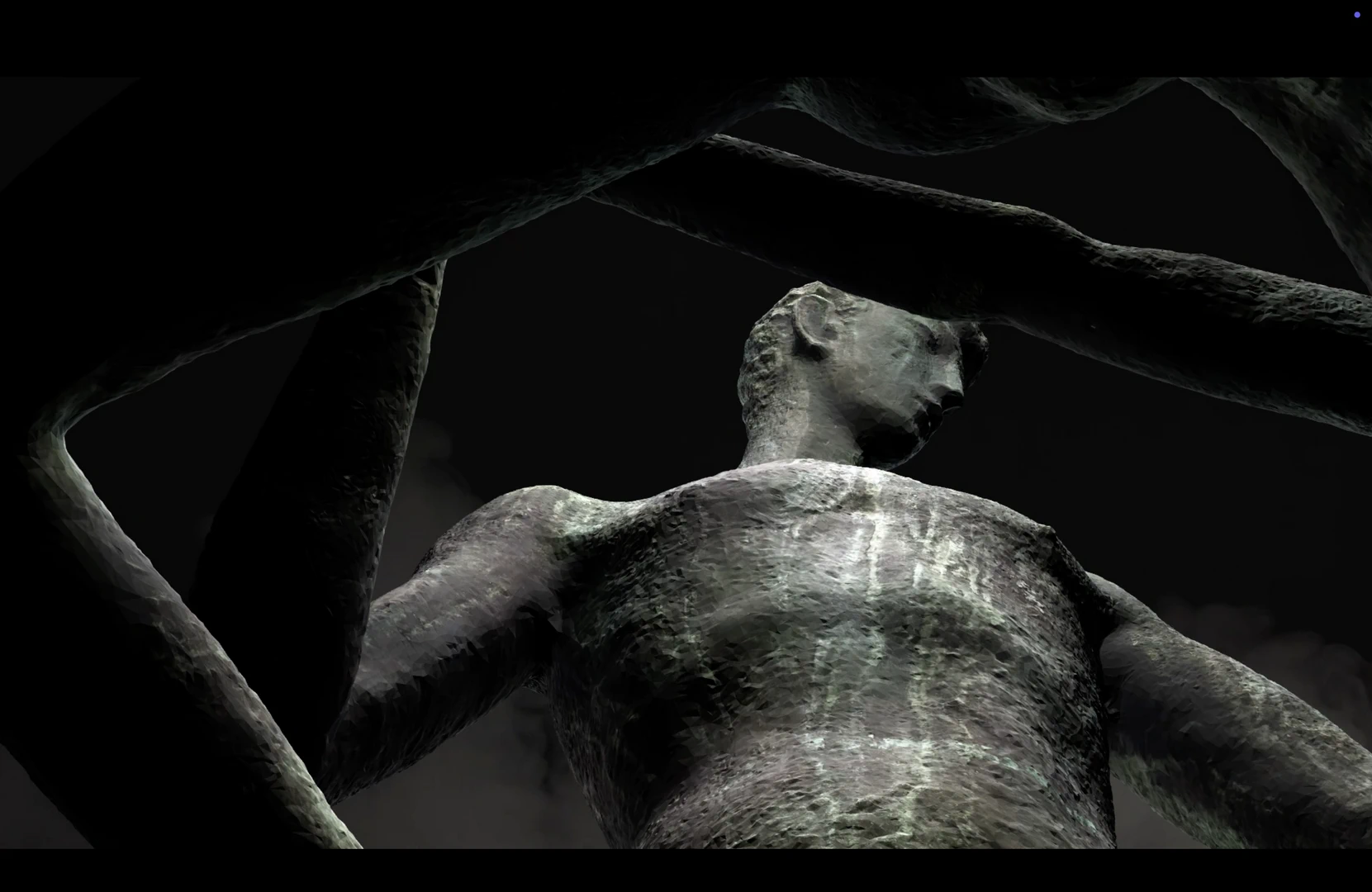
The project Expanded Representations of Postwar Modernist Sculpture uses 3D Animation to explore and interpret the spatial dramaturgy of selected works by sculptor Stojan Batič, one of the most important Slovenian sculptors of the 20th century. His extremely extensive oeuvre includes works in various sculptural materials, from wood, stone and clay to bronze and glass, and throughout his creative path he combined the exploration of the material with the distinct narrative power of the depicted motifs.
The project focuses on Batič’s works in Ljubljana and Carinthia, where he left a strong artistic mark on public space. Of particular importance are the sculptures Ballet and Urška and the Water Man from 1957, which represent a turning point in his work. While Ballet is still marked by softer modeling of form, Urška and the Water Man foreshadows a more pronounced articulation of the surface and the inclusion of geometric elements that would become a recognizable part of his sculptural language. Through the thoughtful use of negative form and dynamic composition, Batič gradually develops an expression that he maintains until his late creative period.
An important aspect of his art is the dramaturgy of space, which was also co-created by his friendship with the playwright Janez Negro. Contacts with theater and Greek tragedy influenced the creation of numerous figural depictions and the extensive Tragos cycle. In it, Batič combines the experiences of the mining cycle, the geometric articulation of form and the influences of post-cubist sculpture, expressing the tension between fate, hope and despair through figures. This pronounced emotional charge is particularly noticeable in works such as Jocasta, presented at the Tragos cycle exhibition at the Moderna galerija in 1984.
In addition to theater, music was also an important source of inspiration. Batič’s understanding of rhythm is reflected in the treatment of sculptural surfaces, where the contrasts between smooth and rough, light and dark create a visual score of space. The sculptor often connected this rhythm with the motif of dance, which we encounter in works such as Mladinsko kolo (1962), Virpazarsko kolo (1963) and the relief Urška and Povodni mož (1964). His personal experience as a dance teacher after World War II thus found a direct echo in his sculptural expression.
Spatial interpretations of sculpture were created as part of the study process at the Faculty of Natural Sciences and Technology in the course Fundamentals of Visual Expression, in the academic year 2025/2026. With the help of modern digital tools and 3D animation, he tries to bring the sculptural space closer to newer ways of experiencing art. The digital medium enables views that are often not perceptible in physical space, and upgrades the experience of observation with a dramaturgically designed visual and sound flow. The project thus opens up new possibilities for interpreting post-war Slovenian sculpture and enables a contemporary audience to read and understand Batič’s artistic oeuvre differently.
University of Ljubljana, Faculty of Natural Sciences and Engineering · student work · mentor: Boris Beja