Urban avba
Boris Beja, Naja Ražem, Jan Češnjevar, Jure Jelenc
Urban Avba, 2026
The traditional women’s headdress – the avba –, which became established in Carniola in the 18th century, long functioned as a distinct status symbol. The social position and identity of the wearer were revealed primarily through the richly embroidered front band, where abstract, geometric, and floral motifs, embroidered with gold thread, were artistically organized in strict symmetry. In most cases, the front band was complemented by a simple white cap. At the turn of the 20th century, Christian symbolism joined the ornamentation, anchoring the avba even more strongly in the spiritual and everyday world of the rural population.
This intertwining of folk ornamentation, floral motifs, symbols, and idealized images of rural life later characterized the work of Maksim Gaspari as well. His illustrations, postcards, and depictions of national costumes contributed significantly to the visual consolidation of the collective perception of Slovenian identity. Gaspari often interpreted the motifs of traditional headdresses, costumes, and decorations sentimentally and narratively, thereby elevating them from functional objects into carriers of symbolic and emotional meaning. In this context, the avba transformed from a status symbol into a cultural icon.
After World War II, women gradually liberated themselves from traditional cultural patterns, and the avba shifted from everyday use into the field of memory and folklore representation, remaining present mainly as an attribute of national-folk music. Among contemporary reinterpretations, the work of Sanja Grcić is worth mentioning; she transformed the avba in black and included modern laser-cutting technologies in the creation process, placing the traditional form into the current design discourse.
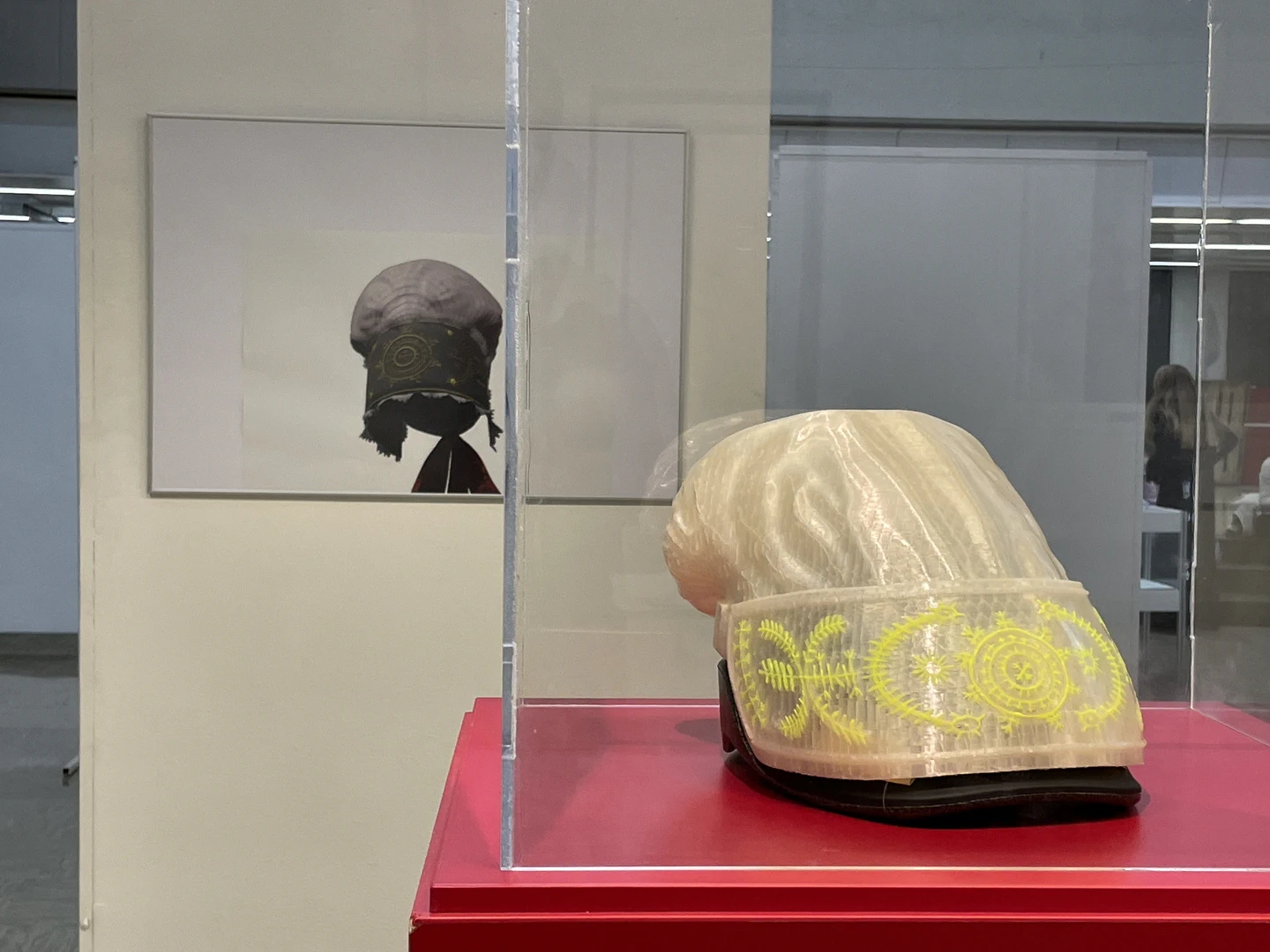
The Bicycle Avba, created by Boris Beja, Naja Ražem, Jure Jelenc, and Jan Češnjevar, interprets tradition in the context of contemporary urban space using 3D technologies. The project connects ethnological heritage with modern users, whereby the product transcends gender divisions and addresses both women and men. The aerodynamically adjusted shape, which was digitally sculpted in Blender, is placed on a ready-made bicycle helmet, and a light source is also integrated into the 3D-printed object to signal the individual’s presence in space in the dark.
The artistic pattern stems from the motif of tattoos that women once wore as symbolic protection against sexual violence. These signs, once inscribed directly onto the body, are transferred in the project into a modern design object that combines heritage, technology, and issues of visibility and, ultimately, safety.
The project also encourages reflection on how to interpret cultural heritage in modern times, adapt it to current users, and use it to draw attention to the diversity of modern society. With a useful product, a dialogue is established between the traditional and the profane, between the physical and the digital, and, through the use of technological tools, a reflection on safety — not only in physical but also in cyber space.
Co-production: University of Ljubljana, Faculty of Natural Sciences and Engineering Department of Textiles, Graphic Arts and Design; Svetlobna gverila / Forum Ljubljana